Written by Rachel Booth-Gardiner.
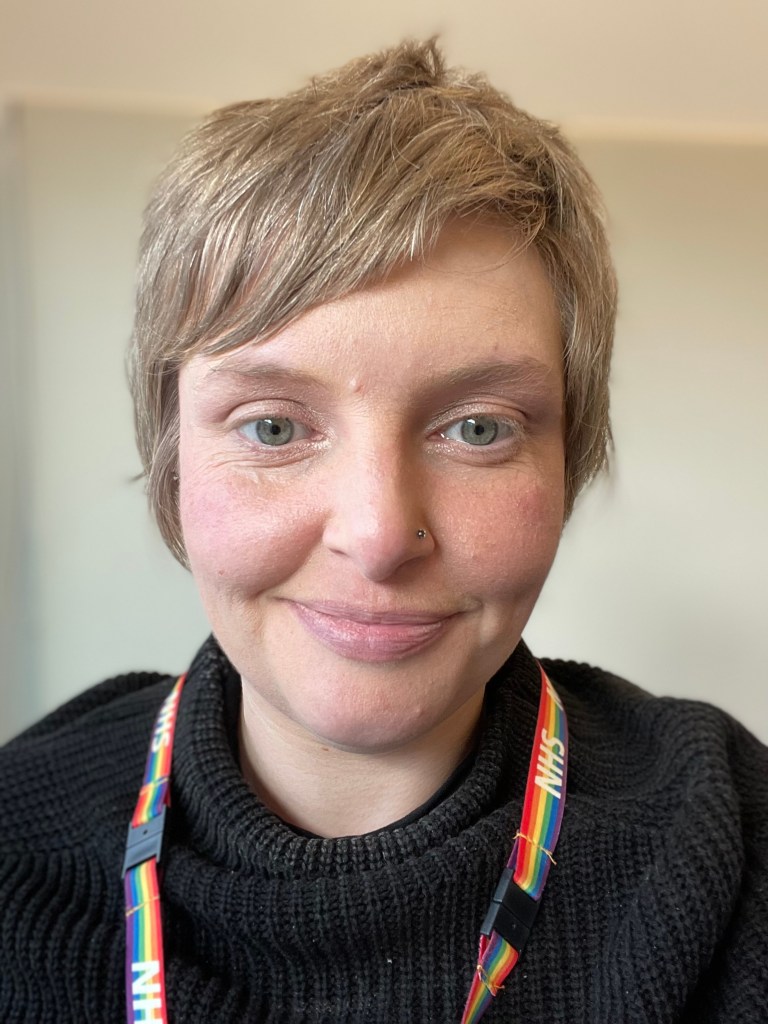
One of the founding members of AbleOTUK Rachel Booth-Gardner explains what disability history month is and why we should celebrate it.
It has taken me a long time to feel comfortable with my identity, but I would describe myself as an occupational therapist who is neurodivergent, born with Cerebral Palsy (right hemiplegia) I am also dyslexic, have experienced episodes of depression, and now live with long covid after an extensive hospital admission and recovery journey, from covid 19. I have written a blog called ‘exploring the art of occupation’ since 2013 which focuses on my thoughts and journey as an occupational therapist with lived experience of disability.
I’m a second generation occupational therapist, having worked within Acute, Rehabilitation, and Forensic mental health settings. I have recently returned to work in my role as Lead Occupational Therapist for Adult Mental Health Acute In-Patients and Rehabilitation services for TEWV NHS Foundation trust. Alongside this I have always been active within the wider Occupational Therapy community, with voluntary roles including; Treasurer of the RCOT Northern and Yorkshire Committee.
OTalk team member helping to run a weekly twitter chat about occupational therapy now in its 11th year.
I’m also a founding member of AbleOTUK, a network and advocacy group for Occupational Therapy staff and students with lived experiences of Disabilities and or Long Term Health Conditions, which launched in 2021.
AbleOTUK have been using their social media platforms to promote awareness of events, and we wanted to celebrate Disability history month which is now in its 12 year but still developing movement. In this blog I explain the ideas behind disability history month.
The United Kingdom Disability History Month (UKDHM) has been celebrated since 2010, taking place from the 3rd week of November for four weeks.
It was founded by Richard Rieser, former teacher and equality champion, after encouragement from those involved in LGBT History Month and advisors on race equality suggested a need for a month to focus on Disability History. Founding Supporting Organisations included the Trades Union Congress, Disability coalitions and Scope. It was also supported by a motion in Parliament on 10th November 2010 signed by 79 members of parliament, and can be viewed on the UK Parliament website the motion reads as;
‘That this House welcomes the first ever Disability History Month that recognises the history of the struggle for equality and human rights; notes that in running from 22 November until 22 December 2010it will cover International HIV/AIDS Day, International Day of People with Disabilities and International Human Rights Day; calls on schools, colleges, universities, local authorities, employers, the public and the media to recognise and celebrate the first UK Disability History Month; encourages them to campaign to improve the unequal position of disabled people in society and work with disability charities and trade unions in the struggle for equality and inclusion; urges the Government to ensure that its policies and latest spending cuts are properly assessed in terms of their impact on people with disabilities so that they do not exacerbate existing inequalities; and looks forward to this month and future years of Disability History Month success.
In a 2013 BBC interview Richard Rieser, said the aim of Disability History Month is “to celebrate the achievements of disabled people, to look at the disablism and oppression that we’ve been subjected to over time in all sorts of cultures and to argue for the full equality that we are entitled to under human rights legislation”.
The Disability history website goes on to share its founding document, that explains the rationale, Guiding Principles, Aims, Organisational Details and lists the Founding Supporting Organisations.
With a key purpose of the month being to raise awareness of the unequal position of disabled people in society and to advocate disability equality; to develop an understanding of the historical roots of this inequality; to highlight the significance of disabled people’s struggles for equality and inclusion and the ‘social model’ of disability;to publicise and argue for the implementation of the United Nations Convention of the Rights of People with Disabilities and the Equalities Act (2010) .
The social model of disability was first developed by Mike Oliver in 1983, largely aimed at health and care professionals. As a way to articulate the idea that people are disabled by barriers in society, not by their impairment or difference, and by changing environments and attitudes toward disability, it creates equality and offers people with disabilities more independence, choice and control.
In 2013 Mike published an article ‘The social model of disability: thirty years on’ in which he remarked that the model took on a life of its own, helping to develop and strengthen the disabled people’s movement by identifying and eradi-cate the disabling barriers which were used in the media to change the images of disability. This led to transport and public buildings becoming much more accessible and changes to legal systems to make it illegal to discriminate against disability.
However he comments most of the model ideas are just still ‘talked about’, arguing that attitudes towards disability particularly within Government, Charities and Organisations still emphasise impairment and difference as a strategy necessary to help protect disabled people. With most political campaigns in defence of benefits and services for those with disabilities has forced disabled people back into the role of tragic victims of impairments and has involved others undertaking special pleading on their behalf.
UK Disability history month Logo is the black triangle with a yellow background. This was used as representation of disabled people reclaiming a part of their history. An inverted black triangle was used as a identification badge in Nazi concentration camps to mark prisoners designated as unsociable which included people with disaiblitiies. The triangle has been turned around and surrounded with a yellow circle.
Each year UKDHM has a theme past themes have been
2010: Education
2011: Campaigning
2012: Hate Crime
2013: Independent Living
2014: War and Impairment
2015: Potrayal of Disability: Then and Now
2016: Disability and language
2017: Disability and Art
2018: Disability and Music
2019: Leadership, Resistance and Culture
2020: Access
2021: Hidden impairments, Sex and relationships
This year UKDHM focusing on Disability, Health and Wellbeing, how this has historically not been addressed with most recent criticism of the covid 19 pandemic disreportly affected the disable over the general public. With an online launch being held on Thursday 17th November 2022.
You are invited to join AbleOTUK throughout Disability History Month via shared content to inspire reflection on our social media platforms. We will also be presenting at the OT Show titled: “Ally-ship: it’s time to make it a meaningful occupation”. Please do engage and search for the hashtag #BeAnAbleOTUKally.
Referances
https://www.public-disabilityhistory.org
https://www.bbc.co.uk/news/blogs-ouch-25188538
http://worldofinclusion.com/ukdhm/
https://forum.scope.org.uk/discussion/86734/uk-disability-history-month-ukdhm
https://www.nhsemployers.org/articles/disability-history-month-2021
https://edm.parliament.uk/early-day-motion/41975
https://www.history.org.uk/ha-news/news/4018/disability-history-month
https://en.wikipedia.org/wiki/Nazi_concentration_camp_badge


One thought on “UK Disability History month – a month in which the struggles of disabled people are remembered, and victories celebrated. 16th November – 16th December 2022”